
RSD 1000.00
Mrs. Nola
Description
Director's note:
When we were already well into the process of creating the play in the library of my childhood bedroom in my parents' house, I found the book Gospa Nola as a special edition, not as part of the Chronicle of the Palanka Cemetery. On the first page it read:
“To Sonja Petrović for outstanding success in recitation competitions”
Primary School "Vuk Karadžić", Bačka Palanka, 13 June 2003. Then I became aware that Gospa Nola has lived inside me much longer and that we have known each other since I was thirteen, from when she has actively lived in me and, in phases of my life, tidies up, destroys and moves things as she pleases.
At the moment the idea of Gospa Nola as a future play became concrete, in my research I realized that when people are asked who Gospa Nola was, they answer almost identically: that she was a woman who could not have children, so she adopted them.
But the point is that nowhere does it say that Gospa Nola could not have children, which means that this assumption belongs to the modern world and has been shaped by other influences and understandings.
The sentence "a woman today always has a choice" seems legitimate now, but compared with Nola's life it also seems like a semblance of reality. The stigmatization of adoption, foster families, and the taboo built around in vitro fertilization work against a situation in which every sixth couple in Serbia faces a problem conceiving naturally, while paradoxically there is greater pressure than ever on women to fulfill themselves as biological mothers and an unprecedented focus on the prenatal period.
The question of biological offspring and natality at all costs is certainly a political issue, perhaps the most fundamental political issue of our time. It is as if we forget the essential questions every parent asks when planning children: in what kind of country will these children grow up, what opportunities will we provide them and which fundamental choices will we enable. Paradoxically, despite all efforts to statistically improve birth rates, parents in Serbia remain isolated on issues of childrearing because the state at every turn neglects the needs of children and young people and daily violates children's rights. Although unintentionally, the real lesson about upbringing, about the essential question of motherhood and parenthood, comes to us from Nola Perčinova, who is not a biological mother, but who is a MOTHER.
She approaches this instinctively, from the need to love, to be loved and to be less lonely, and on that same path she makes mistakes and makes both good and bad decisions. Here the theme of motherhood becomes also a theme of essential patriotism whose definition we have forgotten, and she illuminates its true form and meaning by erasing its false forms with which we are saturated. Those forms that aim, in the name of some grotesque national idea, to turn women into incubators, and to reduce motherhood to mere production, by depriving them of the most important recognition: the period of raising a child in the world and the world within that child.
Because the land will give birth as long as there is land, but who will it feed — that is the question.
Gospa Nola, in a time of occupation of the country, internal and external corruption, political arrests and murders, in a time of forced cultural assimilation, bans on faith, the erasure of language, national identity and national symbols and markings, and a small town as eternal as Bačka, survives as a woman, a single mother. Although in an occupied atmosphere that produces intensified national feelings as a counterpoint, she manages during her life to learn essential patriotism and allows herself to love other peoples and customs, which is the motivation of almost all of Isidora's works into which her cosmopolitan view of the world is woven.
Although, thinking that she failed by not preserving the land as Toša's legacy, she remains and becomes a heroine, a living monument, because she preserved people and raised children.
The land diminishes, it shrinks, and one day all of this will disappear, but there will remain people who respect differences, learn modesty and honest work. Isn't that the true patriotic feeling and mission? Isn't that the essence of motherhood? Motherhood, which has the power not only to create a new world but to shape it according to its measure. Maybe that is precisely why mothers, biological or not, were oppressed, politically persecuted on the one hand, while on the other their essential role and significance were taken away.
Today we look at MOTHERS, the new and the old, those who are yet to become mothers in all the ways a mother is made, as they raise new generations determined to build new families, new estates and a new farmstead Moj mir from the ground up, and to regain the dignity unjustly taken from them.
Sonja Petrović
Ticket: 1,000.00 RSD
- For company
- Art
- For kids
- Theater
- For adults
- For teens
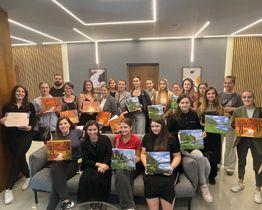
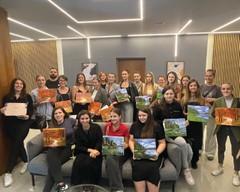
Gift voucher for a painting workshop




Similar events
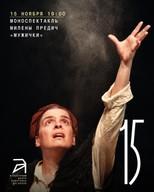
RSD 1000.00
One-woman show by Милена Предич — «Мужички»
Sunday, November 15th
19:00
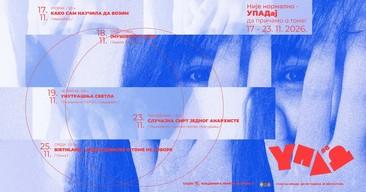
RSD 800.00
How I Learned to Drive
Tuesday, November 17th
20:00
RSD 1000.00
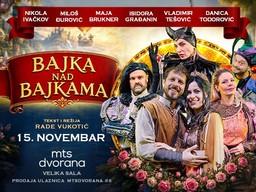
Children's rock musical 'A Fairy Tale Above Fairy Tales'
Sunday, November 15th
12:00
RSD 700.00
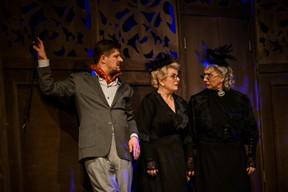
Arsenic and Old Lace
Saturday, November 14th
19:30
RSD 600.00
Whoever Pollutes Nature Will Get in Trouble
Sunday, November 15th
12:00
RSD 800.00
Inner Lights
Thursday, November 19th
20:00